Refresh rate, resolution and panel type all trade off against each other and against price. This hub names specific monitors from the makers' own pages, explains how to choose, and links every monitor guide, including the PS5 picks and the free Dead Pixel Test.
Shop on Amazon
Sponsored
As an Amazon Associate, GameGearLab earns from qualifying purchases. Affiliate disclosure. Images are generic illustrations, not the exact listing.
Gaming Monitors
A general starting point for browsing gaming monitors, covering common refresh-rate and resolution tiers.
Named monitors we chose from the makers' own pages. We did not run lab tests; refresh rates are the makers' listed figures per port. Links are affiliate links.
Simplest for PS5
PlayStation 27" Gaming Monitor
27-inch QHD IPS with two HDMI 2.1 inputs and up to 120 Hz on PS5. PS5 monitor picks.
2560 x 1440 IPS, HDR supported
Up to 120 Hz on PS5, up to 240 Hz on PC and Mac
Two HDMI 2.1 inputs with HDMI VRR, plus DisplayPort 1.4
Decide what you will connect first. A PS5 needs an HDMI 2.1 port for 120 Hz, a PC can use DisplayPort, and a laptop may need USB-C. Then pick resolution and size, then refresh rate and panel type, then extras.
People usually ask about panel type and resolution before refresh rate, and for good reason: both change what you see every day. A refresh rate your hardware cannot supply is wasted money.
Refresh rate
Refresh rate is how often the screen redraws. 60 Hz is the baseline; 144 Hz and 165 Hz are the sweet spot for many players; 240 Hz and above help in fast competitive shooters. The step from 144 Hz to 240 Hz is small, as frame time drops from 6.9 ms to 4.2 ms. See 144Hz vs 240Hz for who benefits.
Time between frames. Frame time is 1000 divided by the refresh rate. Going from 144 Hz to 240 Hz saves under 3 ms per frame, a smaller step than 60 to 144.
Resolution and panel type
1080p is easiest on your graphics card. 1440p is a common balance at 27 inches. 4K is sharpest but needs a strong card or a console. IPS panels give good colour and angles, VA gives deeper contrast, and OLED gives the best blacks and fast response at a premium. Curved screens are a preference; see whether you need a curved monitor.
Consoles, HDMI and DisplayPort
Sony lists 1440p at 60 Hz as the PS5 baseline and 120 Hz needs HDMI 2.1. Read best monitor for PS5 for picks and settings. On PC, DisplayPort often allows higher refresh rates than HDMI; HDMI vs DisplayPort explains the limits.
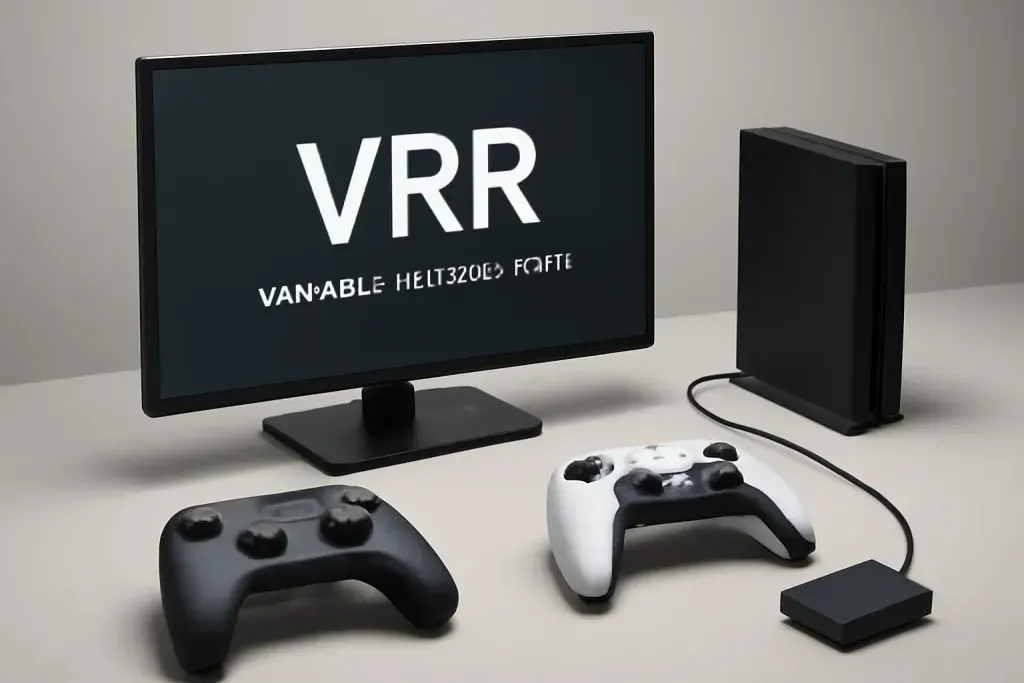
Adaptive sync removes tearing and matters when your frame rate varies; see what VRR does.
Check what you bought
Run the free Dead Pixel Test on arrival to see solid colours and spot stuck pixels while the return window is open. If you notice trails behind moving objects, our response time and ghosting checklist lists the settings to try.
Monitor terms you will see on listings
Refresh rate (Hz)
How many times per second the screen redraws.
Response time
How fast pixels change colour. Makers measure it under their own conditions, so compare cautiously.
Adaptive sync / VRR
The screen matches your frame rate. Names include G-Sync Compatible and FreeSync.
HDMI 2.1
The port version that allows 4K at 120 Hz and VRR on consoles.
DisplayHDR
A VESA label for HDR performance. DisplayHDR 400 is the entry tier.
IPS / VA / OLED
Panel types. IPS has good colour, VA good contrast, OLED the best blacks.
MPRT
A motion measurement some makers list alongside response time.
KVM
A built-in switch to share a keyboard and mouse between two computers.
Mistakes to avoid
Do not buy on refresh rate alone. A fast panel with slow response, a poor stand or the wrong port can disappoint. Check the refresh rate listed for the HDMI port you will use, because a monitor can list a high number over DisplayPort that a console cannot reach.
Do not assume HDR means a bright, vivid picture. Entry HDR labels do little on many panels. And do not skip the return window: run the Dead Pixel Test the day it arrives.
Who should buy what
PS5 players should start with the Sony 27-inch or a 4K HDMI 2.1 model. PC players with a strong card can look at 1440p high-refresh panels like the Odyssey G6. Players who want OLED can look at the AW2725DF and accept the premium. Players who share a monitor between console and PC may like the M28U's KVM.
Competitive players should read our 144Hz vs 240Hz guide before paying extra for speed they cannot feed.
Setup and care
Set the refresh rate in your operating system, since many monitors ship at 60 Hz. Clean the screen with a soft dry cloth, and a barely damp one for marks. Set the stand so the top of the screen is at or slightly below eye level. Keep the monitor away from direct sun.
A buying checklist
Connection. Which ports does your console or PC have, and what refresh rate does the monitor allow on each?
Resolution and size. 27 inches at 1440p is a common balance; 4K suits larger screens and strong hardware.
Refresh rate. Match it to what your hardware can supply.
Panel type. IPS for colour, VA for contrast, OLED for blacks at a premium.
Stand. Height, tilt and VESA mounting matter for comfort.
Returns. Run the Dead Pixel Test on arrival.
Quick troubleshooting
If the refresh rate option is missing, try another cable or port and update the graphics driver. If you see tearing, turn on adaptive sync in the monitor menu and the graphics settings. If you see trails behind moving objects, change the overdrive setting one step at a time. If the picture looks washed out in HDR, check the HDR setting in your operating system. Our ghosting checklist covers these in more detail.
How we choose in this category
We build quick picks from the makers' own spec pages and platform holders' support pages, looking at resolution, refresh rate on each port, panel type and console support. Ports and refresh rate on each input come first because they decide whether your console or PC can use the speed. We do not run lab tests, we do not quote prices, and we leave out any spec we cannot confirm on the maker's page.
Specs change between versions, so confirm the details on the current listing for your region before you buy. Our about page explains our editorial method, and our affiliate disclosure explains how the site earns.
Where to go next
Use the quick picks to shortlist, read the guide linked to each one for the comparison, and use the free tools to check your setup. If you are still not sure, start with the guide that matches your platform. Browse the free tools or the full guides index for anything not listed here.
All Gaming Monitors guides
Every gaming monitors guide on the site, in one place:
Best Monitor for PS5: Picks and Settings: The best monitor for PS5: five named picks, 4K vs 1440p, the HDMI 2.1 and VRR settings to check, and a comparison table built from maker specs.
Do I Need a Curved Monitor for Gaming?: Wondering if a curved monitor for gaming is worth it? Learn the real trade-offs, ideal use cases, and when flat is still the better pick.
HDMI vs DisplayPort for Gaming Monitors: HDMI vs DisplayPort for gaming monitors: learn which connection fits your monitor, GPU, refresh rate and setup best, and what cables to check.
Best 1440p Gaming Monitor: Four Picks by Use: The best 1440p gaming monitor: four named picks for PC and PS5, a comparison table from maker specs, and what to check on panel, refresh rate and ports.
Best Budget Gaming Monitor: Four 24-Inch Picks: The best budget gaming monitor: four named 24-inch 1080p picks, a comparison table from maker specs, and what to check on panel, refresh rate and ports.
1080p vs 1440p for Gaming: Which Should You Pick?: 1080p vs 1440p for gaming: how sharpness, frame rate and graphics card needs compare, a side-by-side table, and monitor picks for each resolution.
Browse Gaming Monitors on Amazon
A monitor pick chosen for a widely useful balance of refresh rate and everyday usability.
The best 1440p gaming monitor: four named picks for PC and PS5, a comparison table from maker specs, and what to check on panel, refresh rate and ports.
The best budget gaming monitor: four named 24-inch 1080p picks, a comparison table from maker specs, and what to check on panel, refresh rate and ports.